
Battery-Powered Balancing Robot DIY STEM Kit
$8.99$4.95
Posted on: Nov 28, 2007
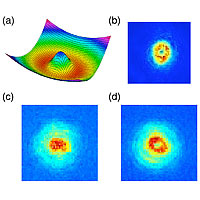
Using laser light to stir an ultracold gas of atoms, researchers at the National Institute of Standards and Technology (NIST) and the Joint Quantum Institute (NIST/University of Maryland) have demonstrated the first “persistent” current in an ultracold atomic gas —a frictionless flow of particles. This relatively long-lived flow, a hallmark of a special property known as “superfluidity,” might help bring to the surface some deep physics insights, and enable super-sensitive rotation sensors that could someday make navigation more precise. The researchers report this feat in an upcoming Physical Review Letters.*
To carry out the demonstration, the researchers first created a Bose-Einstein condensate (BEC), a gas of atoms cooled to such low temperatures that it transforms into matter with unusual properties. One of these properties is superfluidity, the fluid version of superconductivity (whereby electrical currents can flow essentially forever in a loop of wire). Although BECs in principle could support everlasting flows of gas, traditional setups for creating and observing BECs have not provided the most stable environments for the generally unstable superfluid flows, which have tended to break up after short periods of time.
To address this issue, the NIST researchers use laser light and magnetic fields on a gas of sodium atoms to create a donut-shaped BEC—one with a hole in the center—as opposed to the usual ball- or cigar-shaped BEC. This configuration ends up stabilizing circular superfluid flows because it would take too much energy for the hole—containing no atoms—to disturb matters by moving into the donut—which contains lots of atoms.
To stir the superfluid, the researchers zap the gas with laser light that has a property known as orbital angular momentum. (See “‘Tornadoes’ Are Transferred From Light to Sodium Atoms.”) Acting like a boat paddle sweeping water in a circle, the orbital angular momentum creates a fluid flow around the donut. After the stirring, the researchers have observed the gas flowing around the donut for up to 10 seconds. Even more striking, this persistent flow exists even when only 20 percent of the gas atoms were in the special BEC state.
This experiment may provide ways to study the fundamental connection between BECs and superfluids. More practically, the technique may lead to ultraprecise navigation gyroscopes. A BEC superfluid is very sensitive to rotation; its flow would change in fixed steps in response to small changes in rotation. Sound too impractical for airplane navigation? Research groups around the world already have taken the first step by demonstrating BECs on a chip.
* C. Ryu, M. F. Andersen, P. Cladé, V. Natarajan, K. Helmerson and W.D. Phillips, Observation of persistent flow of a Bose-Einstein condensate in a toroidal trap. Physical Review Letters. (forthcoming)