


Hand-Crank Generator DIY STEM Kit
$9.99$5.95
Posted on: Jul 12, 2004
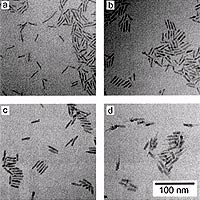
Image courtesy: Lawrence Berkeley National Laboratory
The rage to exploit all things quantum may have hit a snag. Quantum nanorods, atomic structures that have been heralded as the key to everything from super-efficient solar cells to an elusive white laser, appear to have an inherent surface charge that may tarnish their gleaming image, according to a report by University of Rochester scientists in a recent issue of Physical Review Letters.
“This is not a positive nano-tech revelation,” says Todd Krauss, assistant professor of chemistry and principal author of the research. “We’ve found that while perfect nanorods have all this wonderful potential, in reality the current manufacturing process has a serious flaw that gives the rods a charge, and it is this charge that we expect will seriously degrade their usefulness.”
Quantum rods are lengths of latticed atoms of cadmium and selenium that ought to have no overall charge, but Krauss has discovered that while textbook physics says rods should not have a permanent surface charge, in reality they do. He thinks he’s figured out why.
Ideally, quantum nanorods would be constructed of identical layers of bonded atoms. In reality, however, the lattice of cadmium and selenium is skewed, and this imperfect fabrication process creates slightly varied layers that build up to create large disturbances in the overall surface charge profile. Imagine a stack of books where one in the middle is not placed exactly on the one below it; its spine protrudes out one side and its leafed side is sunken into the stack on the other. The overhang allows some of the cover of the book to be visible; in the quantum rod, that visible part of the layer is made of charge-carrying atoms, and their charge disrupts the overall surface charge neutrality of the rod. Improperly stack enough layers in the rod and an appreciable surface charge builds up.
The problem of skewed layers is likely an artifact of the fabrication process, says Krauss. The rods are created in a highly controlled molecular bath where the correct atoms naturally bond in the correct areas. During the rod synthesis, however, many growing rods stick together, creating warps and skewing that only get more uneven as the fabrication continues. Even though the rods are nominally cylindrical, under intense magnification Krauss was able to show that they’re more like tree limbs with knots, bumps, and bends.
“The problem with using these for solar panels or other devices is that they’re charged particles, and that means they’re going to interact,” says Krauss. “For example, making liquid crystals out of quantum rods means thinking about how they aren’t simple neutral particles anymore. Companies are spending millions to design solar cells out of these things, but charged solar cell elements are potentially problematic since they attract the very electron you’re trying to harvest. It’s a really important issue that will have to be addressed before quantum rods reach their full potential for devices of this sort.”
This research was funded by the National Science Foundation, and the New York State Office of Science, Technology, and Academic Research. Working with Krauss were doctoral students Rishikesh Krishnan and Megan Hahn from the University of Rochester, and John Silcox, professor of engineering at Cornell University, with his doctoral student Zhiheng Yu.