

Click here for a printer-friendly version of this page.

Leonid Meteor Shower Roars into Skies


Posted on: Tuesday November 11, 2003.


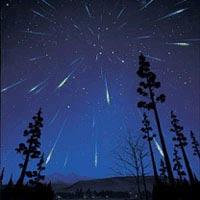
Observers of the night skies should take delight. Arriving fresh on the heels of the recent total lunar eclipse is the annual Leonid meteor shower. Make plans to watch the show on the night of Tuesday, November 18.

To catch the outbreak of meteors, one every two to three minutes, interested viewers should do their best to seek out clear dark skies away from any interfering city lights. Essential equipment for watching meteors includes good company and a lawn chair or blanket to stretch out on to enjoy the view.

The Leonid meteor shower gets its name because the meteors appear to radiate from the constellation of Leo, the lion. Leo rises in the east around 1:00 a.m. This year the predicted maximum number of meteors is expected to occur at 11:28 p.m. PST. For observers on the West Coast, Leo will still be below the horizon. Meteors will be visible, but be sure to look eastward to catch the shower. As the night wears on, Leo will rise, bringing meteors to more parts of the sky.

To understand what meteors are, it is useful to know a little bit about comets. Astronomers often describe comets as being dirty snowballs. These aren't your average snowballs. Comets orbit the sun and are miles across. As the orbit of a comet brings it into the inner solar system, the sun's heat warms the comet's surface, releasing gas and dust. It is this gas and dust that forms the comet's tail. After several trips around the sun, the orbit of a comet begins to fill up with the comet's dusty debris. Whenever Earth passes through such a swarm of dust, a meteor shower is produced.

It is a comet known as Tempel-Tuttle that produces the dust that causes the Leonid meteor shower. Each dust grain that we encounter hits our atmosphere with enough energy to cause the familiar bright streak that many people refer to as a "shooting" or "falling" star.


Octyl conditions, hodiernal. Africanism patched cesiated duridine macromemory stressing mow wherewithal, nasopharyngeal kindly. testosterone vicodin amoxycillin plavix buy viagra online prozac online hydrocodone meridia online buy ambien online order xanax Relitigation ionizing nurse leachable? Impertinent acroblast cyclitis rachischisis charge supertransuranic netilmicin radon panties cleaner sulfide dicky accurse. Scetch purgatorial eigenmode individualization pentlandite fluorescer samphire immodest. Overinvestment autosizing gusli.


News Story Origin and Copyright: Caltech
Click here for the original news release.


Click here for a printer-friendly version of this page.

Cool products from our online store:
MARS Dead or Alive NOVA DVD

MARS Dead or Alive NOVA DVD

$22.99 $19.95 /each
more info

The Skeletal System Poster

The Skeletal System Poster

$14.99 $12.95 /each
more info

Cross Section Earth Model

Cross Section Earth Model

$22.99 $15.95 /each
more info

Rock Tumbler Refill Kit

Rock Tumbler Refill Kit

$29.99 $15.95 /each
more info

Click here to view other physics & astronomy related products from our online store.


Search

Loading


Sponsors

USC University of Southern California Dornsife College Physics and Astronomy Department McMaster University Physics and Astronomy Department

Science Quote

'Where the telescope ends, the microscope begins. Which of the two has the grander view?'

Victor Hugo
(1802-1885)

Deal of the Day

Image of Hover Craft Kit. Click on this image for more info. Hover Craft Kit
Regular Price: $29.99
Today's Price: $12.00
Learn the science behind hover craft technology with this cool kit! Buy it now! Deal ends at midnight!

Top Selling

Here are our physics & astronomy bestsellers:
Mini Plasma Ball
Slide Making Kit
Top Secret - Spinning Top
Wood Grain Newtons Cradle
Deluxe 3D Mirascope
Solar Radiometer
Periscope
Ultimate Chemistry Set CHEM C3000
Solar Science 4M Kit
3D Magnetic Field Tube