


Go to Home Page
You are here
Go to Reference Section
Go to Directories Section
Go to Community Section
Go to Fun Section
Go to Science Store
Go to About PhysLink.com
Top Destinations Menu
 Ask the ExpertsAsk the
Experts

 Physics Job BoardPhysics
Job Board

 Physics and Astronomy Departments DirectoryUniversity
Departments

 FREE Einstein eCardsEinstein
eGreetings

 PhysLink.com Science eStoreScience
eStore


Need an interior designer in the Los Angeles area? Visit: Odeau.com


   Question

How could you direct the laser towards the transparent tank full of water so that 100% of the laser light was reflected?

Asked by: James McDougall

Answer

Almost all of the laser light will be reflected off of the air-glass interface if the incident angle is close to 90 deg. Note that the incident angle is the angle between the laser beam and the normal to the interface.

The figure below shows:

i - incident angle;
r - reflected angle, and
t - transmitted angle.
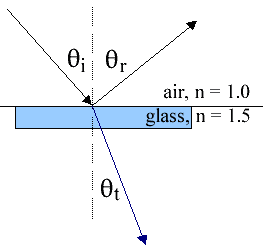


When the incidence angle is high (i.e. i 90 deg) then we call it a grazing or glancing angle - because the incident light beam is approaching the interface almost parallel to it. Almost all surfaces reflect almost all of the incident light at this angle. You can just try holding a book at the level of the middle of your eyes and face a bright light; you will see the light from the source reflected nicely in the cover.

Another example is when you are driving on a straight road and the Sun is just setting in front of you (or you are sitting on a beach facing the ocean and the sunset). The road or the surface of the ocean will become almost completely reflective.

This total reflection at grazing angles is used in x-ray telescopes to reflect x-rays toward the detector. By making a shallow angle conically shaped mirror one can create an x-ray focusing lens.

Answered by: Anton Skorucak, M.S. Physics, PhysLink.com Creator


go to the top  


All rights reserved. © Copyright '1995-'2009 PhysLink.com