
Go to Home Page
You are here
Go to Reference Section
Go to Directories Section
Go to Community Section
Go to Fun Section
Go to Science Store
Go to About PhysLink.com
Top Destinations Menu
 Ask the ExpertsAsk the
Experts

 Physics Job BoardPhysics
Job Board

 Physics and Astronomy Departments DirectoryUniversity
Departments

 FREE Einstein eCardsEinstein
eGreetings

 PhysLink.com Science eStoreScience
eStore


Need an interior designer in the Los Angeles area? Visit: Odeau.com


   Question

What is the equivalent of 1 Lux unit in Watts?

Asked by: Costas

Answer

First, a technical point, Lux is a measure of illuminance, or luminous fLux per unit area, and so the corresponding quantity would be irradiance, or Watts per square meter. As for the answer, it depends on what color you're talking about. The Lux is a photometric unit, rather than a radiometric unit, which means that it takes into account the basic physics of energy and radiation, but also includes the physics of the human eye. Our eyes are simply better at picking up some colors than others. For instance, 1 Watt of yellow light would look a whole lot brighter (be absorbed more efficiently by the eye) than 1 Watt of blue light.

The conversion between photometric units (which take into account human physiology) and straight radiometric units is given by the following: (photometric unit) = (radiometric unit) x (685) x V(Greek lambda), where V(Greek lambda) is the 'luminous efficiency,' and is a function of the wavelength of light. Basically the luminous efficiency tells us how efficiently the eye picks up certain wavelengths of light. Shown below is a graph of V(Greek lambda) from the website given below in reference section.
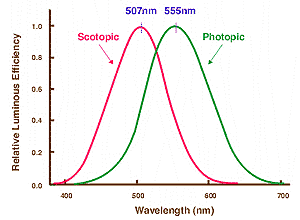
Human eye sensitivity curves

The photopic curve is for normal vision, and the scotopic curve is for eyes that are adjusted to the dark.

An interesting thing to note is that (for day vision) our eyes are most effective at picking up yellow light at around 555 nm - which is also the main wavelength of light emitted by our sun! This is evolution in action, our eyes evolved so as to most effectively utilize the resources available.

As for the question, working backwards from the equation given above will show that .0029 Watts of green light (Greek lambda = 510 nm, V(Greek lambda) = 0.5) will provide an illuminance of 1 Lux, while only .0015 Watts of yellow light (Greek lambda = 555 nm, V(Greek lambda) = 1) provide 1 Lux, and it takes a whopping .015 Watts of red light (Greek lambda = 650 nm, V(Greek lambda) = 0.1) provide 1 Lux.

Reference:


Answered by: Gregory Ogin, Physics Undergraduate Student, UST, St. Paul, MN


go to the top  


All rights reserved. © Copyright '1995-'2009 PhysLink.com