

Go to Home Page
You are here
Go to Reference Section
Go to Directories Section
Go to Community Section
Go to Fun Section
Go to Science Store
Go to About PhysLink.com
Top Destinations Menu
 Ask the ExpertsAsk the
Experts

 Physics Job BoardPhysics
Job Board

 Physics and Astronomy Departments DirectoryUniversity
Departments

 FREE Einstein eCardsEinstein
eGreetings

 PhysLink.com Science eStoreScience
eStore


Need an interior designer in the Los Angeles area? Visit: Odeau.com


   Question

Is there a day and night on the moon?

Asked by: Danielle

Answer

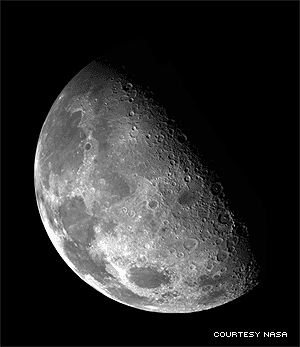
Photo of half-MoonThe transition from day to night is caused by the spinning of the Earth about its axis. We experience day when we are on the half of the Earth facing the Sun, and night once we have been spun around to the other side.

The same occurs on the moon. However, the difference is that It takes 28.5 days for the moon to spin about its axis. So one moon-day is 28.5 Earth-days long!

When we watch the phases of the moon we are actually watching the transition of moon-day to moon-night and vice-versa. Because the moon orbits the Earth in exactly the same amount of time it takes for the moon to complete a turn, the same side of the moon is always facing the Earth. (Originally the moon spun faster, but slowed down to reach this curious steady state). So you can pick a place on the moon and watch over a month as it goes from light to dark (this is called 'waning' and corresponds to moon-dusk) and then back again (waxing, which corresponds to moon-dawn) !

Answered by: Sally Riordan, M.A., Management Consultant, London


go to the top  


All rights reserved. © Copyright '1995-'2009 PhysLink.com