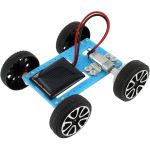

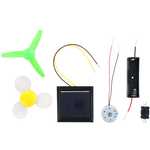
Solar & Battery Fan DIY STEM Kit
$9.99$5.95
Posted on: Jul 15, 2003
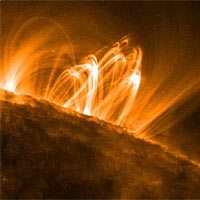
Taken by the Solar and Heliospheric Observatory (SOHO) spacecraft on April 21.
SUPER: NASA / LMSAL
Scientists got their closest-ever ultraviolet look at the Sun from space, thanks to a telescope and camera launched aboard a sounding rocket. The images revealed an unexpectedly high level of activity in a lower layer of the Sun's atmosphere (chromosphere). The pictures will help researchers answer one of their most burning questions about how the Sun works: how its outer atmosphere (corona) heats up to over one million degrees Celsius (1.8 million Fahrenheit), 100 times hotter than the chromosphere.
A team of Naval Research Laboratory (NRL) scientists used the Very high Angular resolution ULtraviolet Telescope (VAULT) to take pictures of ultraviolet (UV) light (1216 Å) emitted from the upper chromosphere. Resolving areas as small as 240 kilometers (150 miles or 0.3 arcseconds) on each side, the June 14, 2002, flight captured images about three times better than the previous-best pictures from space. A few ground-based telescopes can observe the Sun in 150-kilometer (93-mile) increments, but only at visible wavelengths of light. UV and X-ray wavelength observations most directly matter to solar weather.
Since most solar weather originates as explosions of the electrified gas (plasma) in the corona, understanding the heating and magnetic activity of the coronal plasmas will lead to better predictions of solar weather events. Severe solar weather, like solar flares and coronal mass ejections, can disrupt satellites and power grids, affecting life on Earth.
The VAULT observations reveal a highly structured, dynamic upper chromosphere, with structures visible for the first time thanks to the detailed resolution. A large number of structures in the pictures change rapidly from one image to the next, 17 seconds later. Scientists previously thought these changes occurred over five minutes or more. The transience of the physical processes in this layer has significant theoretical implications, such as the fact that proposed heating mechanisms must now also be effective over relatively short time scales.
Scientists found chromospheric features in the VAULT images that match features, based on shape and spatial correlation, which they see in Transition Region And Coronal Explorer (TRACE) satellite images of the corona taken simultaneously. This comparison shows that these two layers have much higher correlation than previously thought and implies that similar physical processes likely heat each. However, theory predicts the activity in the chromosphere should be lower than what scientists observed in the VAULT emissions. "[There are] more things happening below [in the upper chromosphere] than you see in the corona," says VAULT project scientist Angelos Vourlidas of the NRL.
VAULT also revealed unexpected structures in quiet areas of the Sun. The plasma and magnetic field bubble up like boiling water on the Sun's visible surface (photosphere), and, like bubbles gathering and forming a ring at the edge of a pot, the field builds up in rings (network cells) in the quiet areas. VAULT captured images of smaller features and significant activity within the network cells, surprising scientists.
The telescope took 21 images in the Lyman-alpha wavelength of the electromagnetic spectrum during a six-minute-nine-second picture-taking window on its 15-minute flight. Offering the brightest solar emissions, the Lyman-alpha wavelength assured the best likelihood for pictures from the rocket and allowed for shorter exposure times and more pictures. An increase in Lyman-alpha radiation may indicate an increase in solar radiation reaching Earth.
The VAULT payload consists of a 30-centimeter (11.8-inch) Cassegrain telescope with a dedicated Lyman-alpha spectroheliograph focusing images onto a charge-coupled device (CCD) camera. The CCD, also employed in consumer digital cameras, has a photosensitivity 320 times greater than photographic film previously used. The Normal Incidence X-ray Telescope (NIXT) from the Harvard-Smithsonian Center for Astrophysics took the previous best-resolution pictures of the Sun from space in September 1989, also aboard a sounding rocket.
The scientists verified the payload performance with an engineering flight from White Sands Missile Range, N.M., May 7, 1999. The June 14, 2002, flight from White Sands was the first scientific flight of the payload. The NRL team led a campaign combining observations from satellites and ground-based instruments. Scientists plan a third launch in Summer 2004. The mission was conducted through NASA's Sounding Rocket Program.