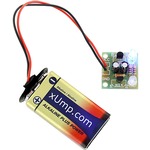
Flashing LED Circuit DIY Electronics Kit
$4.99$2.95

| Posted on: | July 11, 2005 | |
| Employer: | Cornell University | |
| Job Location: | Arecibo, Puerto Rico | |
| Job Category: | Academic Positions | |
| Required Degree: | Doctorate |
The Department Head is expected to maintain a strong program of personal discretionary research; he/she is encouraged to spend 50% of the time on this endeavor. All NAIC scientific staff members have competitive access to the 305-m diameter Arecibo telescope, its suite of receivers spanning the frequency range from 300 MHz to 10 GHz, and its backend signal processors capable of analyzing bandwidths up to 800 MHz. A Mark 5 VLBI system is used for ultra-wideband interferometric observations with other large telescopes in the US and Europe. The newly-operational, multibeam system, the Arecibo L-Band Feed Array (ALFA), and the community-based legacy surveys it supports, provides a wealth of unique opportunities for collaborative scientific engagement with the more than 100 students and scientists who are conducting ALFA survey observations at Arecibo.
The Radio Astronomy Department Head is an employee of Cornell University, the institution that manages NAIC on behalf of the National Science Foundation. As such, he/she will be paid a salary competitive with other prestigious research universities, one that adequately recognizes the responsibilities of the position. The individual will fully participate in the Cornell benefits program. For a suitably qualified individual, an appointment as an adjunct faculty member of the Cornell astronomy department may be appropriate. Collaborative interaction with U.S. academic researchers is an important part of the job and for this reason a generous travel allowance is provided.
A Ph.D in astronomy or a related field, together with at least 7 years research experience in astronomy and a substantial record of published research achievements, is required. Please send a complete curriculum vita including academic, professional and personal data, a research plan and three letters of reference to: Director, National Astronomy and Ionosphere Center, 502 Space Sciences, Cornell University, Ithaca, NY 14853-6801. EOE/AAE. The deadline for receipt of applications and all supporting materials is September 30, 2005. For further information about the NAIC Arecibo Observatory see http://www.naic.edu.
 'I want to know God's thoughts...the rest are details.'