
By what method is the size (or volume) of the universe at the moment of the big bang (or shortly thereafter) determined? Related to this, how is the size of a black hole determined?
Asked by: Todd AndresenAnswer
Actually, we really don't know the absolute size of the universe right now, but the 'Big Bang' is defined as the point when the universe had zero volume. The way it works is that we know, from experiments that the universe is expanding. We've even managed to measure the expansion rate moderately well. So we look for solutions of Einstein's equations of general relativity that have an expanding, homogeneous and isotropic universe. To solve this we need to know the expansion rate today (which we know) and the size today (which we don't really know). However, we can solve for the ratio of the size at some past (or future) time to the size today. If you solve the equation for the time in the past when the ratio was zero, you call that the time of the 'Big Bang' and you've just computed the age of the universe.So the basic answer is that we can't really measure the absolute size of the universe (much of which may even be outside our current horizon) but we can solve for the size relative to the size today.
As for black holes, their size is determined in a completely different way. By the 'size' of a black hole we typically mean the Schwarzschild radius (or 'event horizon' as people like to say). This radius is determined solely by the mass of the black hole and is given by:
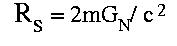
We can then measure the size of the black hole by measuring it's gravitational attraction with other objects near it (like stars) -- and hence its mass.
Answered by: Brent Nelson, M.A. Physics, Ph.D. Student, UC Berkeley