
Go to Home Page
You are here
Go to Reference Section
Go to Directories Section
Go to Community Section
Go to Fun Section
Go to Science Store
Go to About PhysLink.com
Top Destinations Menu
 Ask the ExpertsAsk the
Experts

 Physics Job BoardPhysics
Job Board

 Physics and Astronomy Departments DirectoryUniversity
Departments

 FREE Einstein eCardsEinstein
eGreetings

 PhysLink.com Science eStoreScience
eStore


Need an interior designer in the Los Angeles area? Visit: Odeau.com


   Question

Why an electric bulb needs to be vacuumed? Can we light up a bulb in the space without enclosing in the glass bulb?

Asked by: Muhammad Nasir

Answer

An incandescent light bulb contains a thin wire filament (usually tungsten) that glows hot when an electric current is run through it. In the presence of oxygen, the filament would burn up as a result of the high temperature. A glass bulb, then, is used to keep oxygen away from the filament.

While a vacuum will work, any inert gas that inhibits combustion will also work. Since the vacuum of space would have no oxygen, a bare filament WOULD work as a light bulb without the glass globe.

By the way, even without oxygen present a filament eventually deteriorates as its atoms dissipate. The presence of a halogen gas actually inhibits this deterioration, allowing higher filament temperatures and brighter light bulbs. So the glass globe can also help enhance a bulb's capability.

More info on light bulbs:
Light bulb image by Adrienne Hart-Davis
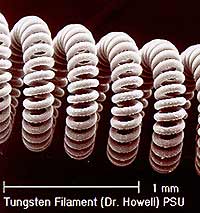
Tungsten filament close-up image by Dr. Howell at PSU, Material Science Dept.
Light bulb by Adrienne Hart-Davis
Light bulb filament close-up


Answered by: Paul Walorski, B.A., Part-time Physics Instructor


go to the top  


All rights reserved. © Copyright '1995-'2009 PhysLink.com