
Question

How much heat per hour do humans dissipate?

Asked by: George West

Answer

The average human (according to my Coke® can's Nutrition Facts label) consumes approximately 2000 Calories per day (it's actually usually somewhere between 2200 and 4000, but 2000 is a nice number). Using a simple conversion (1000 calories = 1 Calorie, 1 calorie = 4.1868 J), this amounts to 8.37 x 10⁶ joules ingested per day.

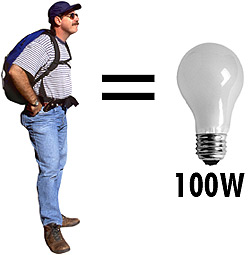
Human energy equivalentThis means that the average person expends ~8.37 x 10⁶ joules of energy per day, since most of us are in some sort of equilibrium with our surroundings. Assuming most of this energy leaves us in the form of heat, I calculate that on average we radiate ~350,000 J of energy per hour. Since Watt is just Joules per second, this is roughly equal to energy given off by a 100 Watt light bulb!


This assumption, that most of our expended energy leaves us in the form of heat, is actually a decent one. Speaking as a relatively normal college student (in all relevant respects), the amount of energy I expend doing non-thermal work on my surroundings every day seems pretty trivial. Aside from playing tennis (during and after which I _very_ actively radiate thermal energy), probably the most energetic thing I do is walk up 5 flights of stairs to my dorm room. This increase in gravitational potential energy, however, is only ~12,000 J, or on the order of 0.1% of my total energy expenditure.

The one thing I have neglected (not being a biologist/chemist/physician/whatever) is chemical and biological changes in the human body that would cause the amount of ingested energy to be different than expended energy. This could be due to things like creation/burning of fat, abnormal heat radiation (such as when the body temperature rises while the immune system combats an illness), or increased activity (such as a weightlifter building muscle mass, although I suspect that at higher levels of activity the body's efficiency drops quite a bit, and the heat/work ratio goes up).

Answered by: Gregory Ogin, Physics Undergraduate Student, UST, St. Paul, MN

Search

Loading


Sponsors

USC University of Southern California Dornsife College Physics and Astronomy Department McMaster University Physics and Astronomy Department

Science Quote

'The strength and weakness of physicists is that we believe in what we can measure. And if we can't measure it, then we say it probably doesn't exist. And that closes us off to an enormous amount of phenomena that we may not be able to measure because they only happened once. For example, the Big Bang. ... That's one reason why they scoffed at higher dimensions for so many years. Now we realize that there's no alternative... '

Michio Kaku
(1947-)

Deal of the Day

Image of Shark Tooth Fossil in Matrix. Click on this image for more info. Shark Tooth Fossil in Matrix
Regular Price: $39.95
Today's Price: $15.00
Superb shark fossil specimen for the science classroom! Buy it now! Deal ends at midnight!

Top Selling

Here are our physics & astronomy bestsellers:
Mini Plasma Ball
Slide Making Kit
Top Secret - Spinning Top
Wood Grain Newtons Cradle
Deluxe 3D Mirascope
Solar Radiometer
Periscope
Solar Science 4M Kit
Ultimate Chemistry Set CHEM C3000
3D Magnetic Field Tube