Go to Home Page
You are here
Go to Reference Section
Go to Directories Section
Go to Community Section
Go to Fun Section
Go to Science Store
Go to About PhysLink.com
Top Destinations Menu
 Ask the ExpertsAsk the
Experts

 Physics Job BoardPhysics
Job Board

 Physics and Astronomy Departments DirectoryUniversity
Departments

 FREE Einstein eCardsEinstein
eGreetings

 PhysLink.com Science eStoreScience
eStore


Need an interior designer in the Los Angeles area? Visit: Odeau.com


   Question

Why is that electrons radiate electromagnetic energy when they are accelerated?

Asked by: Manav Chauhan

Answer

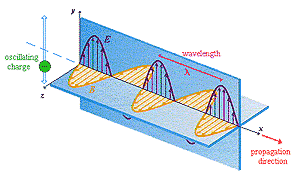
An electromagnetic wave, as its name implies, consists of alternating electric and magnetic fields, oriented at 90 degrees to each other, moving at the speed of light. These alternating fields sustain themselves because electricity (moving electric charges) generates a magnetic field, and a changing magnetic field generates an electric field.

To demonstrate the first of these behaviors, hold a magnetic compass near a wire conducting a DC current. The compass needle will orient itself perpendicular to the wire as long as current is flowing. Electric meters and motors both take advantage of this behavior.

To demonstrate the second behavior, plunge a magnet into a coil of wire connected to a current measuring meter. As long as the magnet is moving, current will flow in the coil. Electric generators take advantage of this behavior.

An electron carries an electric charge. A stationary electron creates no magnetic field. (Like a wire with no current). An electron moving at constant velocity generates a steady magnetic field, but (like a stationary magnet in a coil of wire) a constant magnetic field won't result in another electric field. An electron moving with a CHANGING velocity (ie. accelerating), however, generates a CHANGING magnetic field, which WILL produce a changing electric field, which produces a changing magnetic field, etc. In other words, it generates an electromagnetic wave.

Answered by: Paul Walorski, B.A., Part-Time Physics Instructor


go to the top  


All rights reserved. © Copyright '1995-'2009 PhysLink.com