
Welcome to PhysLink.com - Your physics and astronomy online portal. Stay a while! Check out our extensive library of educational and reference materials. Also, check out our fun section!
|
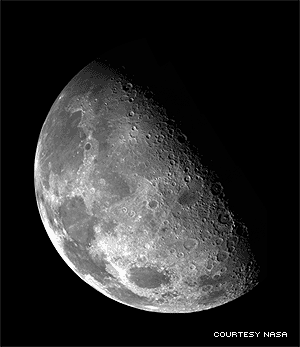
Question Is there a day and night on the moon? Asked by: Danielle Answer The transition from day to night is caused by the spinning of the Earth about its axis. We experience day when we are on the half of the Earth facing the Sun, and night once we have been spun around to the other side.

The same occurs on the moon. However, the difference is that It takes 28.5 days for the moon to spin about its axis. So one moon-day is 28.5 Earth-days long! When we watch the phases of the moon we are actually watching the transition of moon-day to moon-night and vice-versa. Because the moon orbits the Earth in exactly the same amount of time it takes for the moon to complete a turn, the same side of the moon is always facing the Earth. (Originally the moon spun faster, but slowed down to reach this curious steady state). So you can pick a place on the moon and watch over a month as it goes from light to dark (this is called 'waning' and corresponds to moon-dusk) and then back again (waxing, which corresponds to moon-dawn) ! Answered by: Sally Riordan, M.A., Management Consultant, London |
Black Hawk Wolf RC Helicopter
Regular Price: $39.99
Today's Price: $14.00
Easy to fly 3 channel mini remote-controlled helicopter. Buy it now! Deal ends at midnight!
Here are our physics & astronomy bestsellers:
Mini Plasma Ball
Slide Making Kit
The Ultimate Geek Pen
Top Secret - Spinning Top
Thermodynamic Drinking Bird
Wood Grain Newtons Cradle
Deluxe 3D Mirascope
Solar Radiometer
Periscope
Solar Science 4M Kit