
Adaptive optics produces ultrasharp images of sunspot
Posted on: Oct 9, 2005
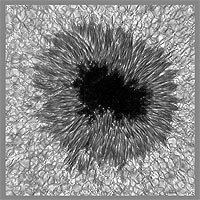
Credit: Friedrich Woeger, KIS, and Chris Berst and Mark Komsa, NSO/AURA/NSF.
Advanced technologies now available at the National Science Foundation's Dunn Solar Telescope at Sunspot, NM, are revealing striking details inside sunspots and hint at features remaining to be discovered in solar activity.
This image, spanning an area more than three times wider than Earth, was made possible by the Dunn's recently completed AO76 advanced adaptive optics image correction system and a new high-resolution CCD camera.
The Dunn is the nation's premier high-resolution solar telescope. The Association of Universities for Research in Astronomy operates the Dunn as part of the National Solar Observatory under a cooperative agreement with the NSF.
This ultrasharp image of sunspot AR 10810 shows several objects of current scientific interest. G-band bright points, which indicate the presence of small-scale magnetic flux tubes, are seen near the sunspot and between several granules (columns of hot gas circulating upward).
The dark cores of penumbral fibrils and bright penumbral grains are seen as well in the sunspot penumbra (the fluted structures radiating outward from the spot). These features hold the key to understanding the magnetic structure of sunspots and can only be seen in ultra high-resolution images such as this one. Magnetism in solar activity is the 'dark energy problem' being tackled in solar physics today.
Normally such features are beyond the grasp of ground-based solar telescopes because of blurring by Earth's turbulent atmosphere. The Dunn's AO76 system compensates for much of that blurring by reshaping a deformable mirror 130 times a second to match changes in the atmosphere and refocuses incoming light. This allows the Dunn to operate at its diffraction limit (theoretical best) of 0.14 arc-second resolution, rather than the 1.0 to 0.5 arc-second resolution normally allowed by Earth's atmosphere.
The Dunn has two high-order adaptive optics benches, the only telescope in the world with two systems, which enhances instrument setup and operations.
This image was built from a series of 80 images, each 1/100th of a second long (10 ms), taken over a period of 3 seconds by a high-resolution Dalsa 4M30 CCD camera in its first observing run after being added to the Dunn. Speckle imaging reconstruction then compiles the 80 images and greatly reduces residual seeing aberrations.
The camera is part of the equipment suite for the Dunn's Diffraction-Limited Spectropolarimeter, which is designed to analyze magnetic field strength and direction inside sunspots.
The Dunn and its new systems are available for the world solar physics community to use.
Technical notes:
* Sunspot AR 10810, observed Sept. 23, 2005, 17:03:47 UTC
* The image was taken and processed by Friedrich Woeger, a graduate student from the Kiepenheuer-Institut fur Sonnenphysik in Freiburg, Germany, with the assistance of Chris Berst of NSO. Woeger is working as a summer student with Thomas Rimmele at National Solar Observatory at Sunspot, NM.
* The camera chip is 2,048 x 2,048 pixels in size. This image is 1,868 pixels square because of the speckle reconstruction technique and other factors.
* The image was taken in G-band, a blue part of the spectrum (430.5 nm) where magnetic features stand out in high contrast. The G-band contains spectral lines formed by CH molecules.
* The finished image spans an angle of about 56 arc-seconds, equivalent to about 3.2 times the diameter of Earth, or 40,630 km (~25,190 miles), at the visible surface of the Sun.
* The companion image includes a NASA image of Earth to scale on the left side and an unprocessed single frame on the right half.
* Dunn Solar Telescope: Aperture, 76 cm; diffraction limit, 0.'14 @ 430.5 nm (G-band) or 0'.17 @ 500 nm.
* Adaptive optics type: Shack-Hartmann wavefront correction system.