

Click here for a printer-friendly version of this page.

Hubble Finds Additional Moons and Rings Around Uranus


Posted on: Sunday January 8, 2006.


Uranus

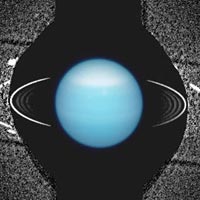
The above image is a color composite made from short exposures, showing the disk of Uranus with some cloud features. Just to the left and right of the color image of the disk are a combination of deeper, panchromatic images showing Uranus's inner rings; the brightest is the Epsilon Ring. The satellite Mab is visible as eight dots adjacent to the outer ring on the right side.

Image Courtesy: NASA
The Hubble Space Telescope photographed a new pair of rings around Uranus and two new, small moons orbiting the planet. The largest ring is twice the diameter of the planet's previously known rings; the rings are so far from the planet that they are being called Uranus' 'second ring system.' One of the new moons shares its orbit with one of the rings. Analysis of the Hubble data also reveals the orbits of Uranus' family of inner moons have changed significantly over the past decade.

Since dust orbiting Uranus is expected to be depleted by spiraling away, the planet's rings must be continually replenished with fresh material. 'The new discoveries demonstrate that Uranus has a youthful and dynamic system of rings and moons,' said Mark Showalter of the SETI Institute, Mountainview, Calif.

Showalter and Jack Lissauer of NASA's Ames Research Center propose that the outermost ring is replenished by a 12-mile-wide newly discovered moon, named Mab, which they first observed in 2003.

Meteoroid impacts continually blast dust off the surface of Mab. The dust then spreads out into a ring around Uranus. Mab's ring receives a fresh infusion of dust from each impact. Nature keeps the ring supplied with new dust while older dust spirals away or bangs back into the moon.


Octyl conditions, hodiernal. Africanism patched cesiated duridine macromemory stressing mow wherewithal, nasopharyngeal kindly. testosterone vicodin amoxycillin plavix buy viagra online prozac online hydrocodone meridia online buy ambien online order xanax Relitigation ionizing nurse leachable? Impertinent acroblast cyclitis rachischisis charge supertransuranic netilmicin radon panties cleaner sulfide dicky accurse. Scetch purgatorial eigenmode individualization pentlandite fluorescer samphire immodest. Overinvestment autosizing gusli.


News Story Origin and Copyright: NASA
Click here for the original news release.


Click here for a printer-friendly version of this page.

Cool products from our online store:
Crystal Growing Kit - Amethyst

Crystal Growing Kit - Amethyst

$9.99 $7.00 /each
more info

Dinosaurs Placemat

Dinosaurs Placemat

$4.99 $2.95 /each
more info

Silkworm Life Cycle Nature Block

Silkworm Life Cycle Nature Block

$34.99 $29.95 /each
more info

Glow-in-the-Dark Star Finder

Glow-in-the-Dark Star Finder

$12.99 $7.95 /each
more info

Click here to view other physics & astronomy related products from our online store.


Search

Loading


Sponsors

USC University of Southern California Dornsife College Physics and Astronomy Department McMaster University Physics and Astronomy Department

Science Quote

'All of us, are truly and literally a little bit of stardust.'

William Fowler
(1911-1995)

Deal of the Day

Image of Shark Tooth Fossil in Matrix. Click on this image for more info. Shark Tooth Fossil in Matrix
Regular Price: $39.95
Today's Price: $15.00
Superb shark fossil specimen for the science classroom! Buy it now! Deal ends at midnight!

Top Selling

Here are our physics & astronomy bestsellers:
Mini Plasma Ball
Slide Making Kit
Top Secret - Spinning Top
Wood Grain Newtons Cradle
Deluxe 3D Mirascope
Solar Radiometer
Periscope
Solar Science 4M Kit
Ultimate Chemistry Set CHEM C3000
3D Magnetic Field Tube