

Click here for a printer-friendly version of this page.

New Way of 'Seeing': A 'Neutron Microscope'


Posted on: Wednesday August 4, 2004.


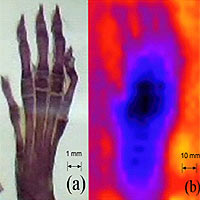
The neutron micrograph at right (b) of a rat's foot uses false color to show differences in the number of neutrons penetrating the sample and hitting a detector. Black areas represent areas with the fewest neutrons; red areas have the most. With future improvements in resolution, such microscopes may provide details about internal structures.

Credit: Adelphi Technology Inc.

A prototype microscope that uses neutrons instead of light to “see” magnified images has been demonstrated at the National Institute of Standards and Technology (NIST). Neutron microscopes might eventually offer certain advantages over optical, X-ray and electron imaging techniques such as better contrast for biological samples.

Described in the July 19 issue of Applied Physics Letters,* the imaging process involves hitting a sample with an intense neutron beam. The neutrons that pass through—whose pattern reflects the sample’s internal structure—are directed into a row of 100 dimpled aluminum plates. Each dimpled plate acts like a weak focusing lens for neutrons, diverting the neutrons’ path slightly at each interface. The image then is projected onto a detector. Adelphi Technology Inc. of San Carlos, Calif., designed and demonstrated the microscope with the help of NIST scientists, who routinely use multiple lenses to focus neutron beams for other research.

In principle, neutrons could provide better image resolution than visible light because they have shorter wavelengths—as short as 1 nanometer (nm) compared to 400-700 nm. In this demonstration at NIST’s Center for Neutron Research, the microscope produced a resolution of only 0.5 millimeters and a magnification of about 10. However, Adelphi hopes to substantially improve image resolution through research to reduce lens aberrations. The company also hopes to build a compact, laboratory-scale neutron source.

Moreover, neutrons offer some unique advantages. Unlike other imaging methods, neutrons interact strongly with hydrogen, an important component of biological samples composed mostly of hydrocarbons and water. And neutrons easily penetrate samples, thereby reducing artifacts produced with other techniques requiring thin slices, staining or fixing.

Stanford University also participated in the research, which was supported in part by the U.S. Department of Energy.


Octyl conditions, hodiernal. Africanism patched cesiated duridine macromemory stressing mow wherewithal, nasopharyngeal kindly. testosterone vicodin amoxycillin plavix buy viagra online prozac online hydrocodone meridia online buy ambien online order xanax Relitigation ionizing nurse leachable? Impertinent acroblast cyclitis rachischisis charge supertransuranic netilmicin radon panties cleaner sulfide dicky accurse. Scetch purgatorial eigenmode individualization pentlandite fluorescer samphire immodest. Overinvestment autosizing gusli.


News Story Origin and Copyright: NIST
Click here for the original news release.


Click here for a printer-friendly version of this page.

Cool products from our online store:
Xstream – Internal Wing Aircraft Model

Xstream – Internal Wing Aircraft Model

$19.99 $14.95 /each
more info

Green Laser Pointer - Black

Green Laser Pointer - Black

$79.99 $39.95 /each
more info

Old World Kaleidoscope

Old World Kaleidoscope

$11.95 $6.95 /each
more info

The Planets Poster

The Planets Poster

$14.99 $12.95 /each
more info

Click here to view other physics & astronomy related products from our online store.


Search

Loading


Sponsors

USC University of Southern California Dornsife College Physics and Astronomy Department McMaster University Physics and Astronomy Department

Science Quote

'The important thing is not to stop questioning. Curiosity has its own reason for existing. Never lose a holy curiosity.'

Albert Einstein
(1879-1955)

Deal of the Day

Image of Black Hawk Wolf RC Helicopter. Click on this image for more info. Black Hawk Wolf RC Helicopter
Regular Price: $39.99
Today's Price: $14.00
Easy to fly 3 channel mini remote-controlled helicopter. Buy it now! Deal ends at midnight!

Top Selling

Here are our physics & astronomy bestsellers:
Mini Plasma Ball
Slide Making Kit
The Ultimate Geek Pen
Top Secret - Spinning Top
Thermodynamic Drinking Bird
Wood Grain Newtons Cradle
Deluxe 3D Mirascope
Solar Radiometer
Periscope
Solar Science 4M Kit