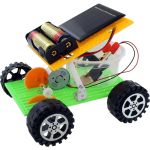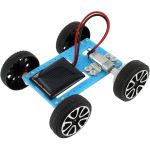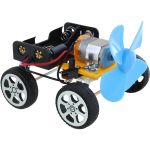




Solar + Battery Car DIY STEM Kit
$11.99$6
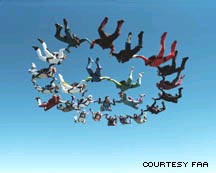 Air resistance increases as your speed increases, so when you first start dropping and are moving slowly, gravity is stronger than the air resistance and you speed up, accelerating towards the ground. However the faster you drop, the stronger the air resistance is and so eventually you are moving so fast that the air resistance is equal in strength to gravity and you don't accelerate any more. You have reached terminal velocity for your current body position.
Why does body position come into it? Because air resistance also depends on the shape of the object (you) and so by tucking in your arms and legs you can reach a faster terminal velocity than if your arms and legs are spread out. But skydivers don't splay their arms and legs to slow down per se (if they were afraid of high speeds we can imagine they would have chosen a different sport). They are trying to achieve a position of dynamic stability.
Dynamic stability is what allows an arrow to fly nose first. If the arrow starts to flip sideways, the air resistance against the fletching is greater than the resistance at the nose, and the arrow automatically goes back to its initial orientation. Likewise, skydivers don't want to be tumbling end over end and out of control, so they trail their arms and feet behind them to act like the feathers on the arrow.
Air resistance increases as your speed increases, so when you first start dropping and are moving slowly, gravity is stronger than the air resistance and you speed up, accelerating towards the ground. However the faster you drop, the stronger the air resistance is and so eventually you are moving so fast that the air resistance is equal in strength to gravity and you don't accelerate any more. You have reached terminal velocity for your current body position.
Why does body position come into it? Because air resistance also depends on the shape of the object (you) and so by tucking in your arms and legs you can reach a faster terminal velocity than if your arms and legs are spread out. But skydivers don't splay their arms and legs to slow down per se (if they were afraid of high speeds we can imagine they would have chosen a different sport). They are trying to achieve a position of dynamic stability.
Dynamic stability is what allows an arrow to fly nose first. If the arrow starts to flip sideways, the air resistance against the fletching is greater than the resistance at the nose, and the arrow automatically goes back to its initial orientation. Likewise, skydivers don't want to be tumbling end over end and out of control, so they trail their arms and feet behind them to act like the feathers on the arrow.
 There is one simple answer. Air resistance. When a mass is moving at speeds like that, air resistance causes them to slow/speed their velocity by their position. If they were in a diving position ' V ' , there is less air resistance, because there is less surface area facing the direction you are going in. If you were to spread all of your limbs out, it causes a much greater surface area, causing more air to collide with your stomach, slowing you down.
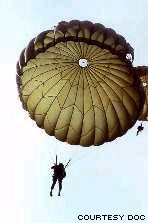
As for parachutes, it needs to cover a wide enough surface area in order to cause enough air resistance to slow the mass down dramatically, that's why a huge snap up occurs when you release your parachute, the huge amount of added air resistance at one time causes such a dramatic slow down. BUT! Circular parachutes need a small hole at the tip in order to prevent a flip around. Air doesn't WANT to be resisted, so it tries its best to cause the smoothest path possible, even if it needs to flip that parachute. So, the hole on top causes a smaller chance of that, but air coming up from that hole is immense. So, the easiest solution is a square shaped parachute. It provides the needed air resistance, without the excess area it covers due to its circular shape. Also, it allows skydivers to "steer" their way to a good landing.
There is one simple answer. Air resistance. When a mass is moving at speeds like that, air resistance causes them to slow/speed their velocity by their position. If they were in a diving position ' V ' , there is less air resistance, because there is less surface area facing the direction you are going in. If you were to spread all of your limbs out, it causes a much greater surface area, causing more air to collide with your stomach, slowing you down.
As for parachutes, it needs to cover a wide enough surface area in order to cause enough air resistance to slow the mass down dramatically, that's why a huge snap up occurs when you release your parachute, the huge amount of added air resistance at one time causes such a dramatic slow down. BUT! Circular parachutes need a small hole at the tip in order to prevent a flip around. Air doesn't WANT to be resisted, so it tries its best to cause the smoothest path possible, even if it needs to flip that parachute. So, the hole on top causes a smaller chance of that, but air coming up from that hole is immense. So, the easiest solution is a square shaped parachute. It provides the needed air resistance, without the excess area it covers due to its circular shape. Also, it allows skydivers to "steer" their way to a good landing.