If you were to design a laser, how would you determine the wavelength of light that would be produced?
Asked by: Stuart SearleAnswer
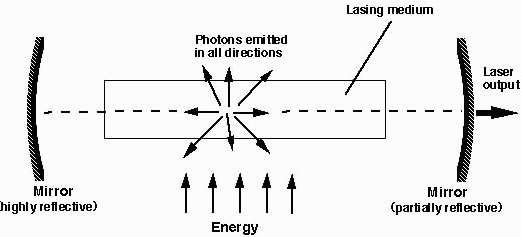
In a laser there is a medium that is the source as well as the amplifying agent of light. When the molecules of the medium are given some energy they will jump to higher energy levels. When they return to lower energy levels they will emit light with energy equal to the difference in the energies of the levels. This light is the source of laser radiation. Therefore one is bound to the available energy level differences (lines) of the medium.Then how is this light amplified? The very first photons move in all directions. Some of them will go and hit one of the mirrors in the laser cavity. It gets reflected and goes back into the medium. When a photon that is reflected and got back to the medium hits an excited molecule it will make the molecule go down to the lower energy level by emitting a photon with the same energy, direction, and polarization. These photons get reflected back and forth between two mirrors (for a laser with two mirrors and the medium) This way the photons grow in number and laser light is generated.
Answered by: Ertan Salik, M.A. Physics, USC