What is meant by the theory that the sun is a third generation star?
Asked by: Brendan WellsAnswer
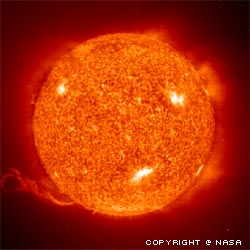 Stars are balls of gas that have condensed from large diffuse clouds of material due to gravity. Presumably after the big bang, large clouds of hydrogen would have been dispersed throughout the universe, and local pockets of higher density would have condensed into the first stars.
As these stars used up their fuel, they would eventually contract and cool as white dwarfs or explode as supernovae (sometimes forming black holes). The scattered material from these dying stars would re supply the local area with atoms from which future generations of stars could condense, and eventually die.
As these stars live and die, light nuclei are fused to form heavier nuclei, providing the energy of the stars as they 'burn'. Thus later generations of stars would start with a higher proportion of heavier nuclei, and would have different spectra than first generation stars. This coupled with estimates of the age of the universe and the age of our sun is how we believe the sun is a third generation star.
Answered by: Rob Landolfi, Science Teacher, Washington, DC
Answer
Many stars, especially comparatively younger ones like the Sun, contain elements heavier than hydrogen and helium that can not be produced by the nuclear fusion reaction that powers them. Iron is one example. This fact leads to the conclusion that these heavier elements must have already existed within the nebula in which our Sun formed. Furthermore, since supernovae typically generate energies high enough to produce most of the heavier elements found in the Sun, deduction leads to the scenario where some ancient star(s) exploded and cast the heavy elements into interstellar space. Subsequently, new stars like our Sun formed from this material. Based on the measured quantities of heavier elements in the Sun it's theorized that it must be a 3rd generation star, that is at least two other stars preceded it.Answered by: Paul Braxton, B.A.