
Welcome to PhysLink.com - Your physics and astronomy online portal. Stay a while! Check out our extensive library of educational and reference materials. Also, check out our fun section!
|
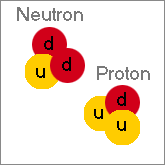
Question Why the masses of proton and neutron are not exactly equal? Asked by: Fatima Bint-e-Munir Answer Protons and neutrons are actually formed from the same fundamental particles, the up and down quark, but in different ratios. The proton is made from two up quarks and a down quark, while the neutron is made from two down quarks and an up quark.
An up quark has a mass of 0.0047 u and a down quark has a mass of 0.0074 u. This does not mean, however, that a proton weighs 0.0168 u or that the neutron weighs 0.0195 u, for they obviously weigh far more (proton, 1.007277 u; neutron, 1.008665 u; this excess weight is due to force interactions between the subatomic particles). However, it does show the reasoning behind the mass difference. Actually, a neutron decays into a proton when outside of the nucleus for too long. In this decay it releases an electron and an antineutrino (of the electron persuasion), effectively becoming a hydrogen atom and energy (antineutrinos don’t exist for very long in nature). The release comes from a down quark that turn into an up quark and a temporary W boson (which breaks down into the electron and antineutrino pair). This process is known as beta decay. Similar processes exist were the inverse happens; this reaction is K capture, as in the letter designating the first energy shell. Answered by: Edward Cramp, Jr., Highschool Student, OVHS, Oley, PA |
Hover Craft Kit
Regular Price: $29.99
Today's Price: $12.00
Learn the science behind hover craft technology with this cool kit! Buy it now! Deal ends at midnight!
Here are our physics & astronomy bestsellers:
Mini Plasma Ball
Slide Making Kit
Top Secret - Spinning Top
Wood Grain Newtons Cradle
Deluxe 3D Mirascope
Solar Radiometer
Periscope
Solar Science 4M Kit
Ultimate Chemistry Set CHEM C3000
3D Magnetic Field Tube