

Battery-Powered Balancing Robot DIY STEM Kit
$8.99$4.95
Posted on: Apr 22, 2005
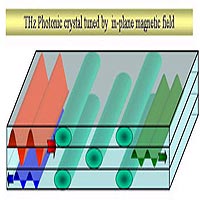
The array of green cylinders inside the sample, forming a so-called photonic crystal, span the width of the sample. These cylinders contain a magnetic field, and act somewhat similarly to bumpers in a pinball machine, scattering the incident electromagnetic waves, shown in red. Only red waves with certain frequencies can propagate through the crystal, resulting in the outgoing transmitted wave shown in green. The rest bounce back, shown as the reflected blue waves.
Image courtesy: UMich
Imagine an imaging technology that could see deep into human tissue without the harmful side effects of radiation. Super-fast oscillations of radio waves, called terahertz (THz) have that promise, but so far, controlling them has been beyond reach.
The array of green cylinders inside the sample, forming a so-called photonic crystal, span the width of the sample. These cylinders contain a magnetic field, and act somewhat similarly to bumpers in a pinball machine, scattering the incident electromagnetic waves, shown in red. Only red waves with certain frequencies can propagate through the crystal, resulting in the outgoing transmitted wave shown in green. The rest bounce back, shown as the reflected blue waves.
But now, by using layered high temperature superconductors, researchers at the University of Michigan and RIKEN, Japan have proposed a way to cherry pick these ultra-fast waves, letting only certain waves pass through, similar to how we tune a radio.
This tunable filter uses a superconducting material with a regular array of spaghetti-shaped magnetic field lines, known as a Josephson vortex lattice, said U-M Physicist Franco Nori, one of the principal investigators on the project. The filter works similarly to the way bumpers on a pinball machine deflect the ball. The result is that the arrangement of ’bumpers’ creates frequency gaps that the waves can’t penetrate. These band gap structures are referred to as ’terahertz photonic crystals.’
Scientists are able to ’tune’ the bumpers by changing an externally applied electromagnetic field, thus selecting which frequencies to let through, and which to keep out, similar to how a radio dial selects some frequencies and weeds out others.
This sort of ’tuning’ is important to developing coherent images with high-frequency radio waves.
Terahertz waves—a trillion oscillations per second—occupy a large portion of the electromagnetic spectrum between the infrared and microwave bands. Although they are considered the next frontier in imaging science, no reliable means of harnessing and controlling this high frequency has been developed, said Nori.
’To push beyond the gigahertz range of frequencies has been very difficult because the waves oscillate so fast that most electronics can’t keep up,’ Nori said. ’Indeed if you look at standard computer chips, it is hard to go beyond a few gigahertz. When you go beyond 100 gigahertz, you approach the terahertz range, the next frontier. The poor circuits just can’t keep up.’
Terahertz radiation represents the last unexplored frontier of the radio wave and light spectrum, Nori said. Terahertz waves can penetrate deep into many organic materials—such as tissue—without the damage associated with ionizing radiation such as X-rays. Also, terahertz radiation can be used to distinguish between materials with varying water content, such as fat versus lean meat. These properties lend themselves to applications in biomedical imaging, as well as quality control. Terahertz radiation can also help scientists understand the complex dynamics involved in materials.
’This is an exciting new frontier, with new research centers on this being started in different parts of the world,’ Nori said.
A paper on the research, ’Using Josephson Vortex Lattices to Control THz Radiation: Tunable Transparency and THz Photonic Crystals,’ is to appear in the April 29 Physical Review Letters. Collaborators are Sergey Savel’ev and A.L. Rakhmanov from The Institute of Physical and Chemical Research (RIKEN), Japan.