

Go to Home Page
Go to Education Section
Go to Reference Section
Go to Directories Section
Go to Community Section
Go to Fun Section
Go to Science Store
Go to About PhysLink.com
Top Destinations Menu
 Ask the ExpertsAsk the
Experts

 Physics Job BoardPhysics
Job Board

 Physics and Astronomy Departments DirectoryUniversity
Departments

 FREE Einstein eCardsEinstein
eGreetings

 PhysLink.com Science eStoreScience
eStore


Need an interior designer in the Los Angeles area? Visit: Odeau.com


Click here for a printer-friendly version of this page.
Hubble Captures a Rare Eclipse on Uranus

Posted on: Sunday September 24, 2006.


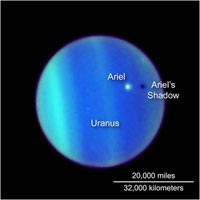
This NASA Hubble Space Telescope image is a never-before-seen astronomical alignment of a moon traversing the face of Uranus, and its accompanying shadow. The white dot near the center of Uranus’ blue-green disk is the icy moon Ariel. The 700-mile-diameter satellite is casting a shadow onto the cloud tops of Uranus. To an observer on Uranus, this would appear as a solar eclipse, where the moon briefly blocks out the Sun as its shadow races across Uranus’s cloud tops. Though such 'transits' by moons across the disks of their parents are commonplace for some other gas giant planets, such as Jupiter, the satellites of Uranus orbit the planet in such a way that they rarely cast shadows on the planet's surface. Uranus is tilted so that its spin axis lies nearly in its orbital plane. The planet is essentially tipped over on its side. The moons of Uranus orbit the planet above the equator, so their paths align edge-on to the Sun only every 42 years. This color composite image was created from images at three wavelengths in near infrared light obtained with Hubble’s Advanced Camera for Surveys on July 26, 2006.

Image courtesy: Hubblesite.org
This image is a never-before-seen astronomical alignment of a moon traversing the face of Uranus, and its accompanying shadow. The white dot near the center of Uranus' blue-green disk is the icy moon Ariel. The 700-mile-diameter satellite is casting a shadow onto the cloud tops of Uranus. To an observer on Uranus, this would appear as a solar eclipse, where the moon briefly blocks out the Sun as its shadow races across Uranus's cloud tops.

Though such 'transits' by moons across the disks of their parents are commonplace for some other gas giant planets, such as Jupiter, the satellites of Uranus orbit the planet in such a way that they rarely cast shadows on the planet's surface. Uranus is tilted so that its spin axis lies nearly in its orbital plane. The planet is essentially tipped over on its side. During the course of its orbit around the Sun, first one pole and then the other is alternately illuminated. As a result, Uranus has extreme seasons during its 84-year orbit around the Sun. The moons of Uranus orbit the planet above the equator, so their paths align edge-on to the Sun only every 42 years.

This transit has never been observed before because Uranus is just now approaching its 2007 equinox when the Sun will shine directly over the giant planet's equator. The last time a Uranian equinox occurred, when transits could have been observed, was in 1965. However, telescopes of that era did not have the image sharpness required to view satellite transits on Uranus. When Hubble was launched in 1990, the Sun was shining over Uranus's far northern latitudes. Over the past decade Hubble astronomers have seen the Sun's direct illumination creep toward equatorial latitudes and the moons' orbits approach an edge-on configuration.

Ariel, named for a mischievous airy spirit in Shakespeare's 'The Tempest,' is only one-third the size of Earth's moon. Ariel is the nearest large satellite to Uranus. As Uranus approaches equinox, there will be additional eclipses by the large moons Umbriel, Titania, and Oberon, and by many smaller moons.
Octyl conditions, hodiernal. Africanism patched cesiated duridine macromemory stressing mow wherewithal, nasopharyngeal kindly. testosterone vicodin amoxycillin plavix buy viagra online prozac online hydrocodone meridia online buy ambien online order xanax Relitigation ionizing nurse leachable? Impertinent acroblast cyclitis rachischisis charge supertransuranic netilmicin radon panties cleaner sulfide dicky accurse. Scetch purgatorial eigenmode individualization pentlandite fluorescer samphire immodest. Overinvestment autosizing gusli.


News Story Origin and Copyright: Hubblesite
Click here for the original news release.


Click here for a printer-friendly version of this page.

Shop at the PhysLink.com Science eStore
TK Little Labs: Stepping Into Science

TK Little Labs: Stepping Into Science

$39.99 $29.95 /each
View details

Solar Print Kit

Solar Print Kit

$16.99 $12.95 /each
View details

Power House Experiment Kit

Power House Experiment Kit

$169.99 $129.95 /each
View details

USB Digital Microscope Eyepiece

USB Digital Microscope Eyepiece

$149.95 $99.95 /each
View details

Click here to view other physics & astronomy related products from our online store.


go to the top  


All rights reserved. © Copyright '1995-'2009 PhysLink.com