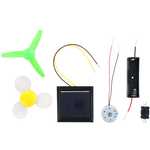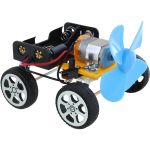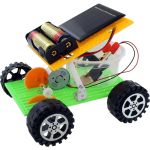
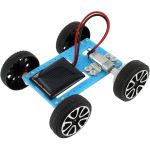
Solar Micro Car Kit DIY STEM Kit
$7.99$4.95
Posted on: Jun 17, 2003
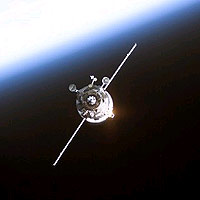
Credits: NASA
Preparations for the Spanish Soyuz mission on the International Space Station (ISS) in October took another step forward with the docking of an unmanned Progress M1-10 spacecraft with the International Space Station, on 11 June at 13:17 Central European Time.
The Progress M1-10 on mission number 11P to the ISS was successfully launched into orbit on Sunday, 8 June at 12.34 Central European Time from the Baikonur Cosmodrome in Kazakhstan. The Progress spacecraft acts as a cargo supply vehicle for the ISS. The Progress M1-10’s cargo included European experiment equipment, which will play a large part in the mission of ESA astronaut Pedro Duque to the ISS in October this year. Whilst on the ISS astronaut Duque from Spain will carry out a number of physical science, human physiology, biology and education experiments.
The Progress supply vehicle was launched from Baikonur Cosmodrome in Kazakhstan on 8 June 2003 The European cargo, which flew in the Progress M1-10 included a major component of the NANOSLAB experiment, which first flew on the flight of ESA astronaut Frank De Winne in November 2002 as part of the Belgian Odissea Mission. This Physical Science experiment has been modified for the Spanish Soyuz Mission.
NANOSLAB is an experiment concerning zeolites. These are crystal formations with structured spaces or pores in them. This allows them to absorb or hold onto other materials such as water. This research has significance in areas including the petrochemical industry. The aim of this experiment is to try and create more effective zeolite crystal structures by mixing different zeolite solutions with a range of crystal-forming catalysts.
Another European experiment, which had major constituents taken to the ISS by the Progress M1-10 was PROMISS-2. This experiment aims to understand the fundamental processes, which underly protein crystallization.
On the educational side of the Spanish Soyuz mission, the following experiments have been uploaded to the ISS from the Progress M1-10:
APIS
This is an experiment aiming to show the difference in the motion of a body rotating about its centre of gravity when its mass is distributed differently.
Thebas
This is an experiment to test basic principles of mechanics. It records the motion of small spheres or liquids in a sealed container at the end of a spring-loaded pendulum.
Video-2
As part of this experiment equipment has been uploaded to the ISS to demonstrate Newton’s three laws of motion under microgravity conditions. This experiment will be recorded, the aim of this being to fit in with the basic physics curriculum for the 12-18 year age group.
In addition to the above experiments, a battery pack has been uploaded to power two further educational experiments (Winograd and Chondro). These experiments will arrive at the ISS on the two following flights along with additional experiment equipment for the Spanish Soyuz Mission. The first flight will be an unmanned cargo flight of Progress M-48, mission number 12P, which will be launched on 30 August. The second will be the flight of Soyuz TMA-3, the spacecraft, which will be taking Pedro Duque to the ISS in October. Other pieces of European hardware, which were transported in the Progress M1-10 were a 3D camera and new crew restraint. The 3D camera will be an invaluable tool in demonstrating the scientific capabilities of the ISS and in upgrading current virtual reality tools used in the ESA’s Erasmus User Centre for training and awareness about the ISS and its facilities.
The new crew restraint is an investigation to improve the current restraint system used on the ISS. To remain in position, astronauts use foot restraints while working. However, it is thought that this causes unnecessary strain on certain small muscle groups. New knee restraints are going to be tested where astronauts can remain in position by using larger muscle groups closer to their centre of gravity.
The above experiments will not be Pedro Duque’s only tasks during the Spanish Soyuz Mission to the ISS. One important mission task that he is involved in is the replacement of the Soyuz TMA-2 spacecraft, the ISS lifeboat, which has been at the station since April. This coincides with the ISS crew exchange.
Duque will be flight engineer on the Soyuz TMA-3 spacecraft, which will take him and the ISS Expedition 8 crew to the ISS. He will return in the Soyuz TMA-2 spacecraft with the Expedition 7 crew (US astronaut Ed Lu and Russian cosmonaut Yuri Malenchenko) who are currently on the ISS.
In preparation for his mission, ESA astronaut Pedro Duque is currently in training in Star City in Moscow and will become the sixth European astronaut to visit the International Space Station.