
Solar & Battery Fan DIY STEM Kit
$9.99$5.95
Posted on: Jul 18, 2004
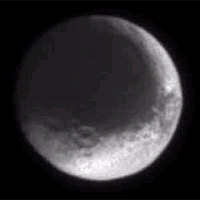
Iapetus' diameter is about one third that of our own moon at 1,436 kilometers (892 miles). The latest image was taken in visible light with the Cassini spacecraft narrow angle camera on July 3, 2004, from a distance of 3 million kilometers (1.8 million miles) from Iapetus (pronounced eye-APP-eh-tuss).
The brightness variations in this image are not due to shadowing, they are real. The face of Iapetus visible was observed at a Sun-Iapetus-spacecraft, or phase, angle of about 10 degrees. The image scale is 18 kilometers (11 miles) per pixel. The image was magnified by a factor of two to aid visibility.
The Cassini-Huygens mission is a cooperative project of NASA, the European Space Agency and the Italian Space Agency. The Jet Propulsion Laboratory, a division of the California Institute of Technology in Pasadena, manages the Cassini-Huygens mission for NASA's Office of Space Science, Washington, D.C. The Cassini orbiter and its two onboard cameras were designed, developed and assembled at JPL. The imaging team is based at the Space Science Institute, Boulder, Colo.
For more information, about the Cassini-Huygens mission visit, http://saturn.jpl.nasa.gov and the Cassini imaging team home page, http://ciclops.org.
Credit: NASA/JPL/Space Science Institute
The moon with the split personality, Iapetus, presents a perplexing appearance in the latest images snapped by the Cassini spacecraft.
One hemisphere of the moon is very dark, while the other is very bright. Scientists do not yet know the origin of the dark material or whether or not it is representative of the interior of Iapetus.
Iapetus (pronounced eye-APP-eh-tuss) is one of Saturn's 31 known moons. Its diameter is about one third that of our own moon at 1,436 kilometers (892 miles). This image was taken in visible light with the Cassini spacecraft narrow angle camera on July 3, 2004, from a distance of 3 million kilometers (1.8 million miles) from Iapetus. The brightness variations in this image are not due to shadowing, they are real.
During Cassini's four-year tour, the spacecraft will continue to image Iapetus and conduct two close encounters. One of those encounters, several years from now, will be at a mere 1,000 kilometers (622 miles).
Iapetus was discovered by the Italian-French astronomer Jean Dominique Cassini in 1672. He correctly deduced that the trailing hemisphere is composed of highly reflective material, while the leading hemisphere is strikingly darker.
This sets Iapetus apart from Saturn's other moons and Jupiter's moons, which tend to be brighter on their leading hemispheres. Voyager images show that the bright side of Iapetus, which reflects nearly 50 percent of the light it receives, is fairly typical of a heavily cratered icy satellite. The leading side consists of much darker, redder material that has a reflectivity of only about 3 to 4 percent.
One scenario for the outside deposit of material has dark particles being ejected from Saturn's little moon Phoebe and drifting inward to coat Iapetus. One observation lending credence to an internal origin is the concentration of material on crater floors, which is suggestive of something filling in the craters.
Iapetus is odd in other respects. It is in a moderately inclined orbit, one that takes it far above and below the plane in which the rings and most of the moons orbit. It is less dense than many of the other satellites, which suggests a higher fraction of ice or possibly methane or ammonia in its interior.
The Cassini-Huygens mission is a cooperative project of NASA, the European Space Agency and the Italian Space Agency. The Jet Propulsion Laboratory, a division of the California Institute of Technology in Pasadena, manages the Cassini-Huygens mission for NASA's Office of Space Science, Washington, D.C. The Cassini orbiter and its two onboard cameras were designed, developed and assembled at JPL. The imaging team is based at the Space Science Institute, Boulder, Colo.
For this and other images and information about the Cassini-Huygens mission, visit http://saturn.jpl.nasa.gov and http://www.nasa.gov/cassini. Images are also available at the Cassini imaging team home page, http://ciclops.org.