


Simple DC Motor DIY STEM Kit
$7.99$4.95
Posted on: Oct 26, 2005
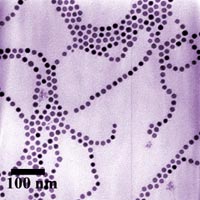
Chains of 1 million magnetic nanoparticles have been assembled and disassembled in a solution of suspended particles in a controlled way, scientists at the National Institute of Standards and Technology (NIST) report. Such particles and structures, once their properties are more fully understood and can be manipulated reliably, may be useful in applications such as medical imaging and information storage.
The NIST work, scheduled to be featured on the cover of an upcoming issue of Langmuir* (an American Chemical Society journal), is the first to demonstrate the formation and control of centimeter-long chains of magnetic nanoparticles of a consistent size and quality in a solution. The researchers spent several years learning how to make cobalt particles with controllable size and shape, and they hope to use this knowledge to eventually “build” useful structures.
The researchers induce the nanoparticles to form linear chains by subjecting them to a weak magnetic field—about the same strength as a refrigerator magnet. The particles line up because the nanoparticles act like tiny bar magnets, all facing the same direction as the applied field. Once this alignment occurs, the attraction between particles is so strong that reversing the direction of the applied magnetic field causes the whole chain to rotate 180 degrees. When the magnetic field is turned off, the chains fold into three-dimensional coils. When the solution is lightly shaken, the chains fall apart into small rings. NIST scientists used optical and transmission electron microscopes to characterize these structures.
Magnetic particles have already been used in medical imaging and information storage, and nano-sized particles may offer unique or improved properties. For example, magnetic nanoparticle dyes may improve contrast between healthy and diseased tissue in magnetic resonance imaging (MRI), a possibility under study by a different NIST research group. The authors of the Langmuir paper are now developing methods to improve the biocompatibility of these magnetic nanoparticles.
*G. Cheng, D. Romero, G.T. Fraser, and A.R. Hight Walker. 2005. Magnetic-field-induced assemblies of cobalt nanoparticles. Langmuir. December. Posted online Oct. 12.