


Doodling Shake Bot DIY STEM Kit
$8.99$4.95
Posted on: Oct 5, 2011
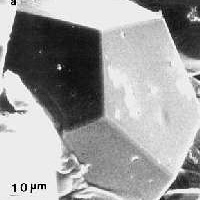
Scanning electron micrograph of single grain of quasicrystal: an Aluminum - Copper - Iron alloy which crystallizes in the shape of a dodecahedron. This is one of the five Platonic solids, containing 12 faces of regular pentagons. Its symmetry is the same as that of the icosahedron, one of the other platonic solid with 20 faces of equilateral triangles.
Image courtesy of An Pang Tsai, NRIM, Tsukuba, Japan.
The Royal Swedish Academy of Sciences has decided to award the Nobel Prize in Chemistry for 2011 to Dan Shechtman Technion - Israel Institute of Technology, Haifa, Israel 'for the discovery of quasicrystals'
A remarkable mosaic of atoms
In quasicrystals, we find the fascinating mosaics of the Arabic world reproduced at the level of atoms: regular patterns that never repeat themselves. However, the configuration found in quasicrystals was considered impossible, and Dan Shechtman had to fight a fierce battle against established science. The Nobel Prize in Chemistry 2011 has fundamentally altered how chemists conceive of solid matter.
On the morning of 8 April 1982, an image counter to the laws of nature appeared in Dan Shechtman's electron microscope. In all solid matter, atoms were believed to be packed inside crystals in symmetrical patterns that were repeated periodically over and over again. For scientists, this repetition was required in order to obtain a crystal.
Shechtman's image, however, showed that the atoms in his crystal were packed in a pattern that could not be repeated. Such a pattern was considered just as impossible as creating a football using only six-cornered polygons, when a sphere needs both five- and six-cornered polygons. His discovery was extremely controversial. In the course of defending his findings, he was asked to leave his research group. However, his battle eventually forced scientists to reconsider their conception of the very nature of matter.
Aperiodic mosaics, such as those found in the medieval Islamic mosaics of the Alhambra Palace in Spain and the Darb-i Imam Shrine in Iran, have helped scientists understand what quasicrystals look like at the atomic level. In those mosaics, as in quasicrystals, the patterns are regular - they follow mathematical rules - but they never repeat themselves.
When scientists describe Shechtman's quasicrystals, they use a concept that comes from mathematics and art: the golden ratio. This number had already caught the interest of mathematicians in Ancient Greece, as it often appeared in geometry. In quasicrystals, for instance, the ratio of various distances between atoms is related to the golden mean.
Following Shechtman's discovery, scientists have produced other kinds of quasicrystals in the lab and discovered naturally occurring quasicrystals in mineral samples from a Russian river. A Swedish company has also found quasicrystals in a certain form of steel, where the crystals reinforce the material like armor. Scientists are currently experimenting with using quasicrystals in different products such as frying pans and diesel engines.