
What are the differences between jet airplanes and rockets?
Asked by: Sameer SinglaAnswer
Both a jet engine and a rocket engine function by expelling hot gases opposite to the direction of desired acceleration. Newton's third law of motion says that the action of the hot gases produces a reaction in the opposite direction on the jet or rocket propelled vehicle; the momentum imparted to the gases is exactly opposite to the momentum imparted to the vehicle.The main difference between the two types of engine is that a rocket carries its own supply of oxygen for combustion. A jet engine requires oxygen from the atmosphere for combustion, and so cannot operate in the vacuum of space.
Answered by: Paul Walorski, B.A., Part Time Physics/Astronomy Instructor
BR>
Answer
Well, one is an airplane, and the other is a rocket! That's quite a difference in my opinion!Joking aside, there are serious differences between the working principles of a jet airplane and a rocket. (The differences in detail are much greater I guess, but I am just a physicist.)
First, let me point out the similarities between the two: Both burn fuel and both eject this fuel mass to gain momentum. Ah, and of course, both 'fly'.
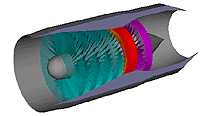 A jet engine works like this: It sucks in air from the front of the engine. This air is burned with the fuel within the engine. The resulting large mass of gas is ejected towards the rear at high velocity, which both propels the airplane forward, and gets more air sucked into the engine. In normal flight, the engines are used to propel the airplane _forward_. The actual 'uplift' is gained through the wings using the strong flow of the wind. (How actually the wings lift the airplane is a bit controversial, there is the 'Bernoulli' side, and the 'Newton' side... But that's another story.)
A rocket, in contrast, carries both fuel (which may be solid or liquid) and oxygen. Therefore it does not suck in air from the front. All it does is burn the fuel with the oxygen, and eject it at very high velocities backward. This momentum is used to both lift and propel the rocket. There are no wings for uplift. Any wings are for steering purposes.
A rocket is generally much more powerful and wasteful than a jet engine. Most airplanes (don't know of any exceptions) can not possibly climb vertically, while rockets are built just to do that. A jet airplane is pretty much useless outside the atmosphere, but a rocket will work just fine since it carries its own fuel and oxygen.
Answered by: Yasar Safkan, Ph.D., Software Engineer, Noktalar A.S., Istanbul, Turkey
Answer
The biggest difference between a jet engine and a rocket lies in their propulsion systems. A jet engine combines oxygen from the air with fuel at high temperature. There is usually a spark to ignite the fuel vapor, but once the engine begins turning, it will continue running until it runs out of fuel or air. The jet is pushed forward by the hot gas coming out the back, the same way a garden hose pushes back on you when you spray it. The rocket engine, by comparison, is not what's called an 'air-breather'.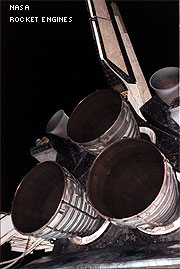 Rockets can work anywhere, in vacuums, or in the atmosphere. A good example of this would be the space shuttle, which uses both of main types of rocket engines. The large nozzles you see at the bottom of the Shuttle itself and liquid-fueled rocket motors. They spray liquid hydrogen and liquid oxygen together, right at the bottom of the cone, which then burns as long as it continues to be fed fuel and oxygen. The rocket, however, doesn't use any air. It will work at any altitude, or in space. The problem is, though, that now, the craft must not only carry fuel... but it must carry oxygen as well. The huge brown tank on the belly of the Space Shuttle is the main fuel tank, holding both hydrogen and oxygen. To lift all that weight requires a LOT of energy, which requires more fuel, which requires more space, and weight; and at a certain point, using liquid-fueled rockets, you start to work against yourself. You can see how large the Saturn V rockets were compared to the Space Shuttle, and you can compare payloads. This is where the solid rocket boosters come in.
The long, relatively thin rockets flanking the Space Shuttle are solid rocket boosters. The solid rocket boosters are filled with aluminum oxide powder. There is a small section of starter material in the bottom of get them started, and once they get started, that's it. Therein lies the most gigantic problem of solid rockets... they can't be shut off. The solid boosters have more power than the liquid engines, they weigh less, they are much much much more reliable, but they can't be shut off. If they could, the Challenger wouldn't have gone down.
So there it is, in a nutshell. Jet engines mix air and fuel, and burn it to propel themselves, liquid rockets mix fuel and oxygen, and have to carry both all by themselves. Solid rockets carry all their fuel internally, and are light, but they can't be stopped once they are started. I hope that answers everything for you.
Answered by: Frank DiBonaventuro, B.S., Physics grad, The Citadel, Air Force officer