
There are two persons in a plane which is traveling at a speed greater than the speed of sound. If one of them talks, will the other hear it?
Asked by: JLMBAnswer
Of course. Two people sitting in your run-of-the-mill supersonic airplane such as the Concorde can easily carry out conversations, without much trouble. If the plane is not accelerating, and they didn't see the outside through the windows, they could hardly tell they are in an airplane.Why is this so? This is because the air is at rest inside the cabin. It is being carried forward by the airplane just as the passengers are. Since sound propagates in air, and air is at rest with respect to the speakers, everything will operate just as well as it does in your living room. (Equally well in first class and economy class, I might add.)
I will expand the discussion a bit though: Suppose we did something quite hard to do in practice and took off the top of the cabin so that air at supersonic speeds travels throughout the cabin. And we also assume that people can breathe, stay alive, and even speak under these conditions. In that case, can they speak to each other or not?
What happens in this case is, the sound from any source propagates not in all directions, but only in a cone backward from the source. The opening angle of this cone depends on the exact speed of the aircraft. The faster the airplane, the narrower the cone will be.
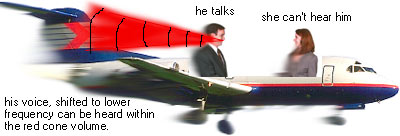
We can make the following observations:
- To hear someone, you must be in their 'cone of speech'. This means that you
definitely have to be behind them, and preferably not too much to the side.
- If you hear someone, they definitely do not hear you. So, no two people can carry
out a conversation without moving. (Try drawing two cones, facing the same
direction, and such that each contains the vertex of the other.)
- How much you scream really makes no difference.
Answered by: Yasar Safkan, Ph.D., Sofware Engineer, Noktalar A.S., Istanbul, Turkey
Additional answer that points out the Doppler effect ...
If they are both in the same airplane, then yes, they will hear each other just fine. The reason for this is that the air inside the enclosed cabin is traveling with them at the same speed, so they are actually not moving at all with respect to the sound-transmitting medium around them.
If it were Superman 1 and Superman 2, however, zipping through the air faster than the speed of sound (Superman 2 following Superman 1) without the aid of technology, the story would be different. In this case they are both traveling faster than the speed of sound in their immediate vicinity.
If Superman 2 started talking, there would be no way for Superman 1 to hear him, since Superman 1 is flying faster than the sound which is trying to catch up to him. Actually, a bunch of the sound emitted by Superman 2 would pile up in his 'sonic boom,' while the rest would be emitted behind him and Doppler shifted to a lower frequency.
If Superman 1 started talking, Superman 2 would hear it just fine. The sound from Superman 1 directed forward would also pile up in his 'sonic boom,' but the sound directed backward would reach Superman 2. As far as Doppler shifting, the sound going backwards from Superman 1 would be shifted to a lower frequency as he is a moving source, but it would be Doppler shifted back to the normal frequency with respect to Superman 2 because he is a moving observer.
For help visualizing sonic booms and (to some extent) doppler shifting, I liked this description: http://www.howstuffworks.com/question73.htm . Also, any classical physics text will most likely address Doppler shifting.
Answered by: Gregory Ogin, Physics Undergraduate Student, UST, St. Paul, MN