
Why the masses of proton and neutron are not exactly equal?
Asked by: Fatima Bint-e-MunirAnswer
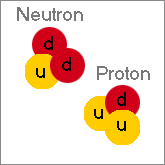 Protons and neutrons are actually formed from the same fundamental particles, the up and down quark, but in different ratios. The proton is made from two up quarks and a down quark, while the neutron is made from two down quarks and an up quark.
An up quark has a mass of 0.0047 u and a down quark has a mass of 0.0074 u. This does not mean, however, that a proton weighs 0.0168 u or that the neutron weighs 0.0195 u, for they obviously weigh far more (proton, 1.007277 u; neutron, 1.008665 u; this excess weight is due to force interactions between the subatomic particles). However, it does show the reasoning behind the mass difference.
Actually, a neutron decays into a proton when outside of the nucleus for too long. In this decay it releases an electron and an antineutrino (of the electron persuasion), effectively becoming a hydrogen atom and energy (antineutrinos don't exist for very long in nature). The release comes from a down quark that turn into an up quark and a temporary W boson (which breaks down into the electron and antineutrino pair). This process is known as beta decay. Similar processes exist were the inverse happens; this reaction is K capture, as in the letter designating the first energy shell.
Answered by: Edward Cramp, Jr., Highschool Student, OVHS, Oley, PA